Blog
How to Choose and Apply Plastic Security Seals: A Practical Guide for Logistics Professionals
Somewhere along a three-week ocean transit, a pallet of branded electronics arrived at the distribution center with its wrapping intact — but six cartons short. No signs of forced entry on the outer packaging. No tamper-evident seal on the pallet wrap. Just a neatly restacked layer and a missing signature.
Plastic security seals are often the first line of defense in exactly these situations. They’re inexpensive, lightweight, and when used correctly, they make pilferage visible. The challenge isn’t sourcing them — it’s knowing which type to buy, how to apply them properly, and how to spot a seal that’s been compromised.
This guide walks through everything a logistics coordinator, warehouse supervisor, or compliance officer needs to know about plastic security seals in 2026.
What Is a Plastic Security Seal — and What Is It Not?
A plastic security seal is a single-use, tamper-evident device made from polypropylene or nylon. Once locked, it cannot be removed without visible destruction. That destruction — a broken locking head, a cut strap, or a deformed body — is the evidence.
Plastic seals are indicative seals under ISO 17712:2013. That means they signal tampering; they don’t physically prevent it. A bolt seal can resist cutting tools. A plastic seal cannot. Understanding this distinction is critical to matching the right seal to the right application.
Where plastic seals work well:
- Soft goods pallets and shrink-wrapped loads
- Tamper-evident bags (cash bags, document pouches, evidence bags)
- Low-to-medium risk container closures where cost efficiency matters
- Utility meter enclosures (water, gas, electric meters) — this is the core territory for Meter Seals, a category-specific variant of the plastic seal
- Drum valves, IBC containers, and tank closures
Where plastic seals are not enough:
- ISO 17712 High Security applications requiring bolt seals
- C-TPAT compliant container closures on high-value cargo lanes
- Any environment where cutting tools are accessible
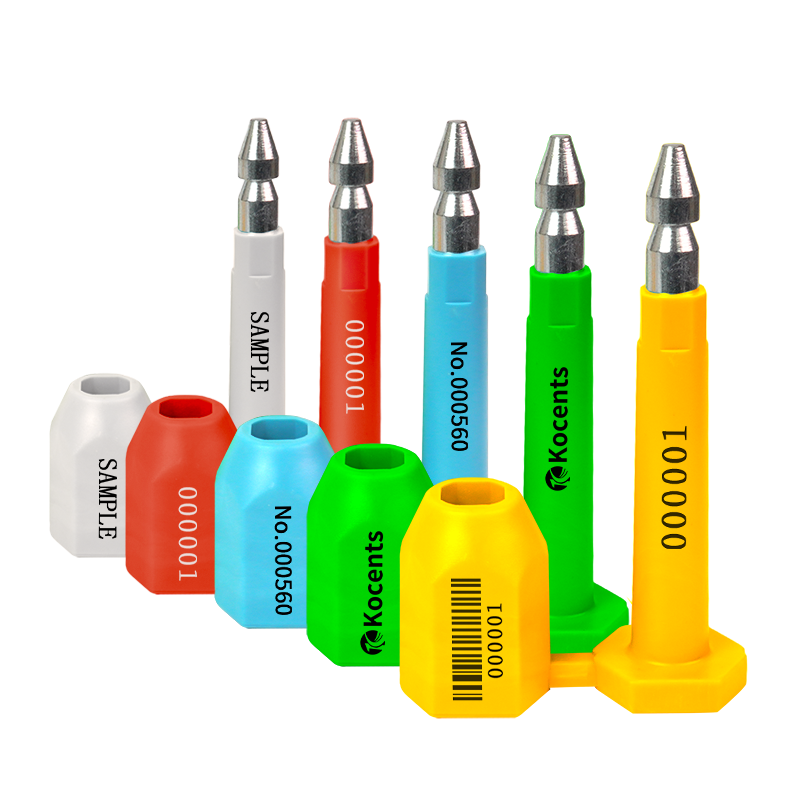
If your shipment requires a Bolzen Dichtung or Kabel Dichtung — say, a steel shipping container moving through a high-theft corridor — a plastic seal won’t satisfy the requirement. For container door closure, consider Bolt Seals (ISO 17712 H-type) or Cable Seals (ISO 17712 S-type). For maximum physical deterrence, Metal Strap Seals add a second layer of structural resistance.
Types of Plastic Security Seals: Pull-Tight vs. Fixed Loop
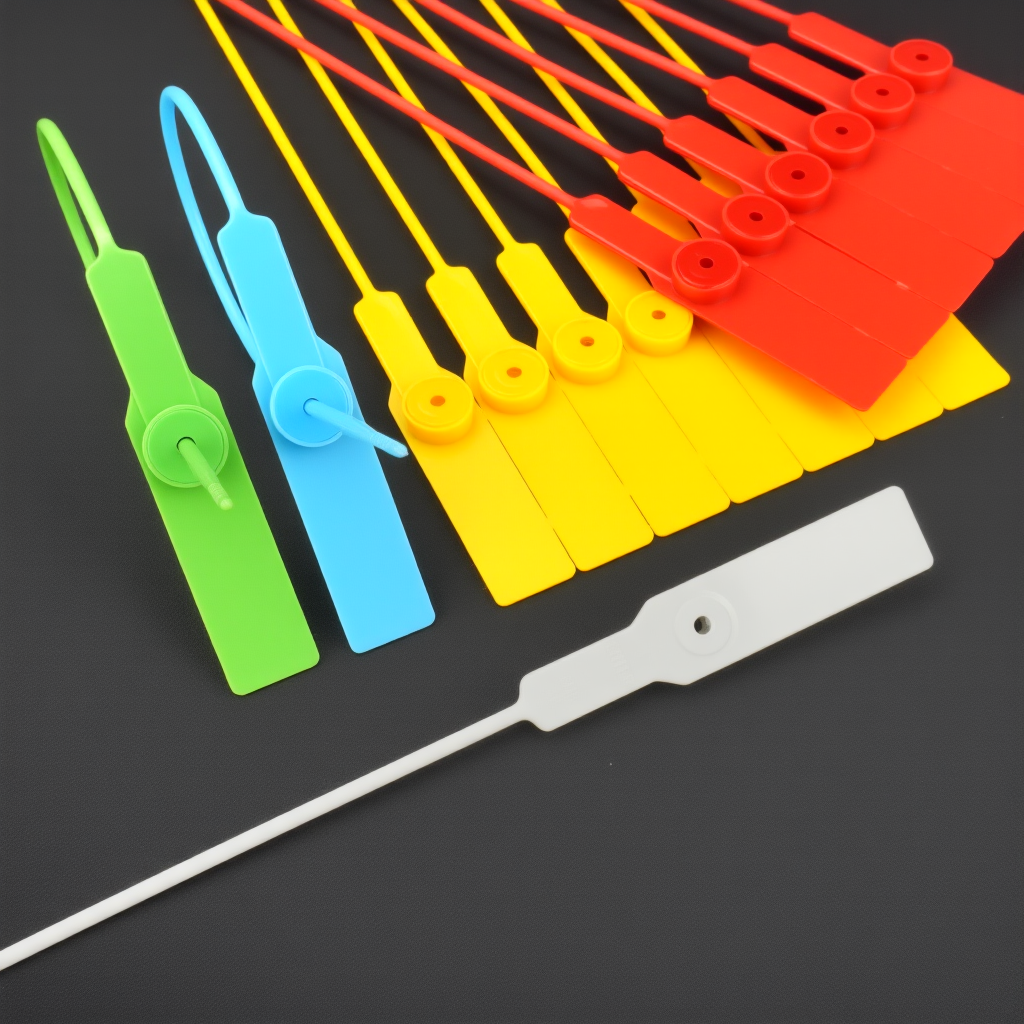
Not all plastic seals are interchangeable. The two dominant formats are pull-tight (also called ratchet or adjustable) and fixed-loop (also called snap-close). Choosing the wrong format causes workflow problems on the receiving end.
Pull-Tight Plastic Seals
The most common type. A toothed strap threads through a locking head; pulling tightens the seal and locks the teeth. The fit adjusts to the diameter of what’s being sealed — a bag closure, a ring of valve handles, a drum vent port.
Best for: Bags, sacks, drum valves, valve clusters, uneven or irregular closure points Limitation: Adjustable length means the seal can sometimes be slipped off if the closure point has slack — always verify the loop is tight before finalizing
Fixed-Loop Plastic Seals
A pre-formed loop snaps shut. The loop diameter is fixed at manufacture. These are faster to apply in high-volume environments like sorting operations or baggage handling.
Best for: Standardized bag handles, uniform closure loops, baggage sealing, zipper pulls Limitation: Won’t accommodate varying diameters
Bolt-Style Plastic Seals
A plug-and-socket design where a rigid pin clicks into a locking housing. More tamper-resistant than pull-tight models; easier to confirm closure at a distance. Some versions include serialized body printing for barcode scanning.
Best for: Soft-wall containers, trailer door handles, transit bags Note: Not equivalent to metal bolt seals — these are still plastic indicative seals
How to Read a Plastic Seal’s Security Features
Before buying in bulk, learn what differentiates a security seal from a generic plastic tie wrap. Reputable manufacturers build in multiple tamper indicators:
Unique serial numbers: Every seal in a consignment should carry a different serialized number. Verify that numbers are sequential and that your order documentation matches the serial range. Pre-numbered seals allow break-bulk detection: if seal #00453 shows up on a container that was sealed with #00447, something went wrong.
Barcode or QR printing: Higher-spec plastic seals carry a barcode that can be scanned into your TMS or WMS at departure and arrival. This is a cost-effective step toward the visibility that RFID Seals provide at the top end of the product range — real-time tracking without manual scanning.
Non-transferable locking teeth: A quality pull-tight seal’s teeth bite in one direction only and cannot be reversed without destroying the locking head. Test a sample before your first bulk order: lock the seal, then try to back the strap out without cutting. If it loosens, reject the product.
Brittle-fracture body design: The body of a security seal should crack or visibly deform if someone tries to heat and re-form it. Look for seals with body sections that cannot be cleanly re-welded.
Color coding options: Many operations use color-coded seals by route, day of week, or cargo type. A receiving dock that spots the wrong color immediately before breaking the load has a built-in alert mechanism.
Step-by-Step: Applying a Pull-Tight Plastic Seal Correctly
Incorrect application is one of the most common reasons seals fail to do their job. Here’s the correct procedure:
Step 1 — Inspect before use. Before applying any seal, visually check for cracks in the body, pre-engaged teeth, or deformed locking heads. A compromised seal from the box is a liability.
Step 2 — Record the serial number. Log the seal number, the closure point, the date, and the person applying the seal. Paper or digital — both work. This record is your baseline for verification at destination.
Step 3 — Thread correctly. For pull-tight seals, insert the strap through the locking head with the teeth facing the correct orientation for the direction of pull. Check the manufacturer’s arrow markings.
Step 4 — Apply with proper tension. The strap should be snug — tight enough that there’s no slack loop that could be slipped over the closure point. Don’t overtighten on flexible plastics or fabric, which can distort the closure.
Step 5 — Confirm the lock. Tug the tail of the strap in the opposite direction of pull. It should not move. A seal that loosens under this test is defective or incorrectly threaded.
Step 6 — Document and hand off. Write or scan the seal number onto the transport document. The receiving party needs this number to verify authenticity before breaking.
Inspecting Seals at Destination: What to Look For
The value of a plastic seal comes entirely from this moment. Train your receiving staff on what a compromised seal looks like — because not all tampered seals look obviously broken.
Look for:
- Locking head cracks or fractures, even small ones
- Strap surface cuts that don’t go all the way through (a partial cut lets the strap still hold tension while hiding evidence of tool use)
- Serial number mismatches — seal number on the load doesn’t match the shipping document
- Heat marks, glossy spots, or re-fused plastic suggesting the body was melted and re-formed
- Wrong color — if your operation uses color coding, an off-color seal is an immediate red flag
- Two locking heads on the same strap (some tampering methods involve cutting and re-locking with a second unit)
Any of these findings should trigger a stop-and-report procedure before the load is accepted. Document the finding with photos and retain the seal as evidence.
Plastic Seals in the Broader Security Architecture
No single seal type covers every application. A mature logistics security program uses a layered approach:
| Anmeldung | Recommended Seal Type | Rationale |
|---|---|---|
| Container door (high value cargo) | Bolt Seal (ISO 17712 H-type) | Physical cut resistance; C-TPAT compliant |
| Container door (low-medium risk) | Cable Seal (ISO 17712 S-type) | Flexible, adjustable; cuts visible immediately |
| Container hasp / secondary lock point | Vorhängeschloss-Siegel | Reusable frame; tamper-evident insert |
| Pallet wrap / soft goods | Plastic Seal (pull-tight) | Cost-effective indicative seal |
| Bulk bag valve / drum port | Plastic Seal (fixed loop / bolt style) | Tight closure on irregular diameters |
| Utility meter enclosure | Meter Seal (polypropylene variant) | Utility-industry standard dimensions and colors |
| Railcar / tank car hasp | Metallbandverschluss | Heavy-duty abrasion resistance |
| High-value electronics / pharma | Container Lock Seal with RFID | Real-time tamper alert, chain-of-custody log |
This table illustrates a key principle: plastic seals are part of a system, not a standalone solution. For operations handling temperature-sensitive pharmaceuticals or high-value cargo, pairing a plastic pallet seal with a Container Lock Seal or an RFID-Siegel on the container door provides both physical evidence of tampering and digital chain-of-custody data.
Compliance Notes: Plastic Seals Under ISO 17712 and C-TPAT
ISO 17712:2013 classifies security seals into three categories:
- H (High Security): Bolt seals and other metal seals resistant to common removal tools
- S (Security): Cable seals — resistant to some removal tools
- I (Indicative): Plastic seals — visible evidence of tampering, no tool resistance
C-TPAT (Customs-Trade Partnership Against Terrorism) requires ISO 17712 compliant high-security seals on containers moving through its program. That means plastic seals alone do not satisfy C-TPAT container closure requirements. However, plastic seals remain appropriate and compliant for internal sealing points within a C-TPAT shipment — pallet closures, bag seals, and secondary hasp seals on trailers operating in lower-risk domestic legs.
If you’re unsure whether your current plastic seal supplier provides ISO 17712 certification for their products, request the test report. Indicative seals can carry ISO 17712-I certification, which documents the tamper-evidence performance of the product against the standard’s specified tests.
FAQ
Q: Can I reuse a plastic security seal? A: No. Plastic security seals are single-use by design. Attempting to reuse one defeats the tamper-evidence function. Any seal that appears to have been re-locked should be treated as compromised.
Q: What is the difference between a plastic seal and a cable seal? A: A cable seal uses a steel wire inside a plastic or metal housing — it provides more physical resistance to cutting than a pure plastic strap seal. Under ISO 17712, cable seals are “S” (Security) type, while plastic pull-tight seals are “I” (Indicative) type. Use cable seals when you need more than just tamper evidence but don’t require the full cut resistance of a bolt seal.
Q: How many plastic seals does a standard 40-foot container need? A: At minimum, the container door locking bars require one bolt seal or cable seal (ISO 17712 compliant) for C-TPAT purposes. Plastic seals are typically added at internal closure points: individual pallet loads, inner cartons, or secondary hasp points. A well-documented container audit might use 10–50 plastic seals across all closure points, depending on cargo type and risk level.
Q: Do plastic seals work in extreme cold or heat? A: Standard polypropylene seals perform well from around -20°C to +70°C. If your operation involves deep-freeze warehousing or desert transport environments outside this range, request cold-chain or high-temperature grade seals and ask your supplier for the temperature test data.
Q: Can I print custom serial numbers or logos on plastic seals? A: Yes — most manufacturers offer laser-printed, hot-stamped, or injection-molded serial numbers. Custom logo printing and color options are standard for bulk orders. Pre-numbered seals with your company’s prefix are common for large distribution operations.
Q: How do plastic seals compare to RFID seals? A: A plastic seal provides visual tamper evidence — you can see if it’s been broken. An RFID seal adds a digital layer: an embedded passive UHF RFID chip logs each scan event, creating an automated chain-of-custody record without manual serial number entry. For operations with high shipment volume and tight audit requirements, the labor savings from RFID scanning can offset the cost premium relatively quickly.
Closing Thoughts
Plastic security seals are a basic tool with a deceptively specific skill set attached. Choosing the right type, applying it correctly, and training receiving staff to inspect it properly — these steps determine whether your plastic seal functions as evidence or wallpaper.
Start by mapping every closure point in your operation against the risk profile of what’s inside. Match each point to the right seal category — plastic indicative, cable security, high-security bolt, or electronic RFID. Then standardize your serialization and documentation so that every seal tells a story from departure to delivery.
Explore our Plastic Seal collection for serialized pull-tight and fixed-loop options suited to bag, pallet, and drum applications. For container door closures requiring ISO 17712 compliance, check out our Bolt Seal and Cable Seal ranges. Contact our team to learn more about building a layered seal program matched to your specific cargo and compliance requirements.
Subscribe to our newsletter for more logistics security insights delivered directly to your inbox.
Verwandte Beiträge
Securing the Cold Chain: How Tamper-Evident Seals Protect Pharmaceutical and Perishable Cargo in 2026
A practical guide to deploying tamper-evident seals across cold chain logistics — covering pharmaceutical compliance, frozen food theft prevention, and RFID-enabled visibility for temperature-sensitive shipments.

How to Protect High-Risk Shipments: A Security Seal Deployment Guide for Logistics Managers in 2026
Learn how to assess cargo theft risk, select the right security seals by type, and deploy a layered protection strategy for high-value logistics operations.
Container Security Best Practices 2026: A Field Guide to Protecting Every Shipment
Unlocking Security: A Comprehensive Guide to Plastic Seals in Modern Logistics